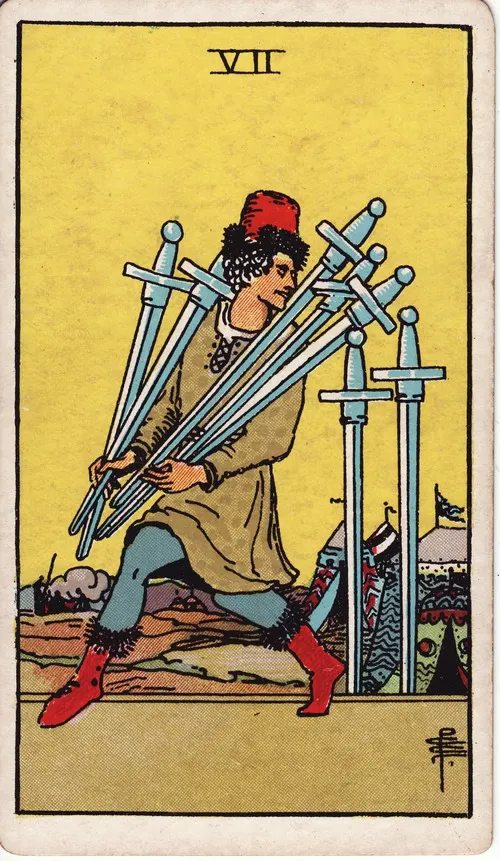
Seven of Swords
宝剑七
The Seven of Swords symbolizes strategy, concealment, and cunning. Upright, it means seeking a new approach while watching for dishonesty; reversed, it suggests confession, accountability, and exposure.
Upright vs Reversed
| Upright | Reversed | |
|---|---|---|
| Keywords | strategyconcealmentcunninga new approach needed | confessiontaking responsibilityexposurereturn to integrity |
| Meaning | Suggests that a new strategy is needed and warns of concealment or shortcuts. When a frontal approach fails, cleverness helps—but not at the cost of honesty. | What was hidden comes to light; confession and responsibility offer the way out. Returning to integrity brings relief. |
Correspondences
| Element | Air |
|---|---|
| Suit Theme | thought, conflict, and truth |
| Rank | Seven of Swords (number 7) |
Frequently Asked Questions
What does Seven of Swords mean upright?
Upright, Seven of Swords carries the keywords: strategy, concealment, cunning, a new approach needed. Suggests that a new strategy is needed and warns of concealment or shortcuts. When a frontal approach fails, cleverness helps—but not at the cost of honesty.
What does Seven of Swords mean reversed?
Reversed, Seven of Swords carries the keywords: confession, taking responsibility, exposure, return to integrity. What was hidden comes to light; confession and responsibility offer the way out. Returning to integrity brings relief.
What does Seven of Swords suggest in love and career questions?
In readings, this card directs attention to the areas of thought, conflict, and truth. Consider its upright and reversed energies together, then relate them to the specific relationship or work situation rather than applying one fixed meaning.
What can I do after drawing Seven of Swords?
Use it as a prompt for reflection rather than a prediction: note which part of the message resonates most, connect it to the question asked, and decide on one concrete next step.
References & Sources
The Rider–Waite Tarot was first published in 1909 by William Rider & Son of London, conceived by Arthur Edward Waite and illustrated by Pamela Colman Smith.
Psychiatrist C. G. Jung introduced the principle of synchronicity (1952)—meaningful coincidences linked not by cause but by meaning—as a way to understand experiences such as divination.
— C. G. Jung, Synchronicity: An Acausal Connecting Principle (1952)
In the Waite tradition the Swords are the suit of Air: thought, reason, conflict, and the pursuit of truth—even when it cuts.
— Waite’s description · A. E. Waite, The Pictorial Key to the Tarot (London: William Rider & Son, 1910).
Further reading:
Disclaimer
The content on this page is for entertainment and self-reflection only and does not constitute medical, psychological, legal, or financial professional advice.
Draw Seven of Swords yourself and see where it falls.