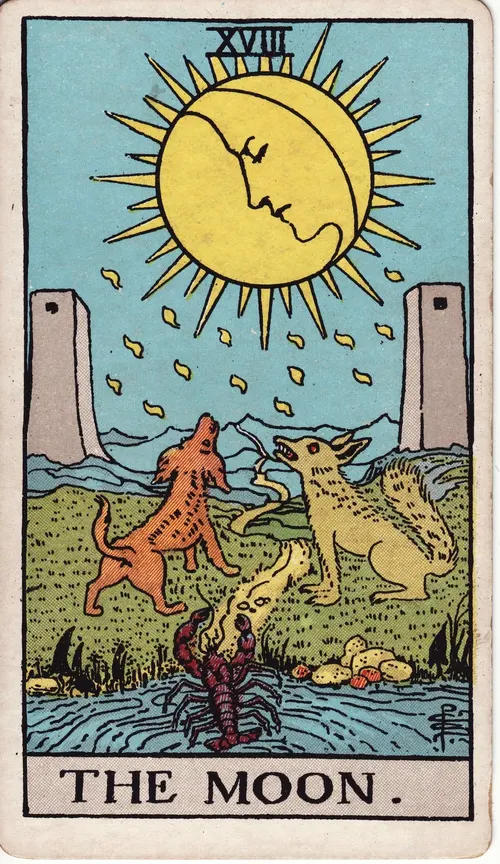
The Moon
月亮 · 18
The Moon represents illusion, fear, the subconscious, and uncertainty. It describes periods when appearances mislead, anxiety rises from within, and truth is only partly visible. Reversed, it signals the release of fear, confusion beginning to clear, and concealed truths gradually surfacing.
Upright vs Reversed
| Upright | Reversed | |
|---|---|---|
| Keywords | illusionfearsubconsciousintuitionuncertainty | releasing feartruth revealedconfusion clearing |
| Meaning | Symbolizes illusion, fear, and the subconscious. Things may not be as they seem—trust intuition. | Fear is dissolving and truth is about to surface. The period of confusion is ending. |
Correspondences
| Element | Water |
|---|---|
| Astrology | Pisces |
| Hebrew Letter | Qoph (ק) |
Frequently Asked Questions
What does The Moon mean upright?
Upright, The Moon carries the keywords: illusion, fear, subconscious, intuition, uncertainty. Symbolizes illusion, fear, and the subconscious. Things may not be as they seem—trust intuition.
What does The Moon mean reversed?
Reversed, The Moon carries the keywords: releasing fear, truth revealed, confusion clearing. Fear is dissolving and truth is about to surface. The period of confusion is ending.
What does The Moon suggest in love and career questions?
In readings, this card directs attention to life decisions and personal growth. Consider its upright and reversed energies together, then relate them to the specific relationship or work situation rather than applying one fixed meaning.
What can I do after drawing The Moon?
Use it as a prompt for reflection rather than a prediction: note which part of the message resonates most, connect it to the question asked, and decide on one concrete next step.
The Moon feels unsettling—is it a bad card?
It is not a matter of good or bad. The Moon signals ambiguity, the unknown, and magnified fear; when information is incomplete, pause judgment and separate fact from imagination.
References & Sources
The Rider–Waite Tarot was first published in 1909 by William Rider & Son of London, conceived by Arthur Edward Waite and illustrated by Pamela Colman Smith.
Psychiatrist C. G. Jung introduced the principle of synchronicity (1952)—meaningful coincidences linked not by cause but by meaning—as a way to understand experiences such as divination.
— C. G. Jung, Synchronicity: An Acausal Connecting Principle (1952)
The Moon: It images the twilight region of illusion, fear, and the undeveloped mind.
— Waite’s description · A. E. Waite, The Pictorial Key to the Tarot (London: William Rider & Son, 1910).
Further reading:
Disclaimer
The content on this page is for entertainment and self-reflection only and does not constitute medical, psychological, legal, or financial professional advice.
Draw The Moon yourself and see where it falls.